
P17566944593073679
Toys Made in China
The label is about geography. The price is about steel tooling.
Open prices per unit and per carton. No registration, no sales rep, minimum order total 2,000 CNY (≈ $313), no company required — you can buy as an individual. Both prices — per unit and per carton — are open before you order.
«Made in China» is read as a verdict on quality. It is not one — it is a statement about where the steel is.
Understanding why the industry sits there explains the thing buyers actually care about: why the price is what it is, and why it changes so sharply between one toy and another.
The real reason
Most of a plastic toy’s cost is decided before the first piece exists, when someone cuts a steel mould. After that, each piece is resin, electricity and seconds.
So the question that decides price is not «how cheap is the labour» but «has this mould already paid for itself». A tool that has run a million pieces adds almost nothing per piece. A new tool has to be recovered from your order alone.
That is why an existing model is cheap and your own shape is not, and why the gap between them is measured in thousands rather than percentages.
Why there
Around the toy districts sit the mould makers, the resin suppliers, the printers, the packaging plants, the electroplating shops, the testing laboratories and the freight consolidators — within a short drive of each other.
The practical effect is speed of iteration. A tool can be modified and back on the machine in days. A packaging change can be printed the same week. That density is the part other countries find hardest to copy, and it matters more than any single cost line.
One more figure worth having in mind, and it is not ours: according to reporting by the Hong Kong outlet HK01 in January 2024, Chenghai accounts for about 33% of the world’s toy production capacity, with more than six million toys leaving the district every day, more than 50,000 toy businesses registered there and over 125,000 people employed in the trade. We cannot verify those numbers ourselves — we cite them with their source and date rather than as our own measurement — but they put the scale of a single district into perspective.
Each cluster specialises: Chenghai in Shantou for plastic toys, Guangzhou for electronics and ride-ons, Yiwu for small goods and party items. Our wholesale markets page goes through what each is actually for.
Measured
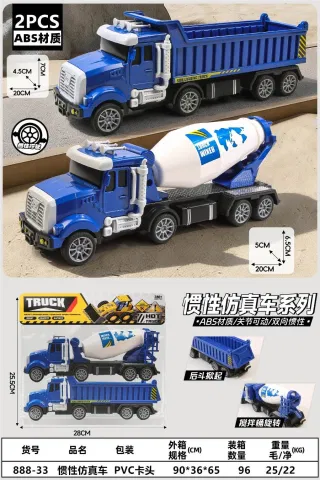
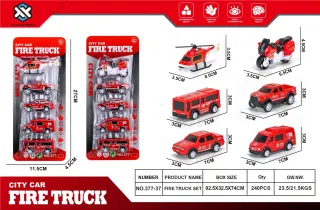
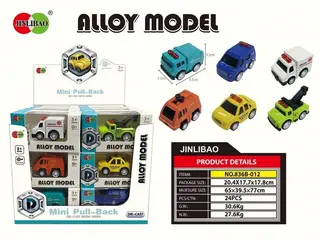
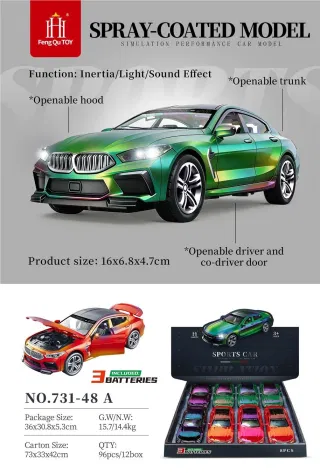
Measured across our own 385,341 items: the median is ¥9.30 a piece, 52% are under ¥10 and 92% under ¥50.
By category the medians run from flags and fan gear at ¥1.35, hair accessories ¥1.50 and glow toys ¥1.62, up through cars ¥8.60 and plush ¥13.00, to radio-controlled ¥28.80, play structures ¥42.00 and ride-ons ¥49.00.
The spread is not arbitrary. It tracks part count, material grade, hand finishing and whether the thing has a motor — all of which are decisions made at the mould, not at the negotiation.
Honestly
The same districts, often the same streets, make the cheapest unbranded toy and the one that arrives in a European box with a familiar name on it. Sometimes the same machines.
So «made in China» tells you the geography and nothing else. What differs between two toys from that geography is the tooling, the specified materials, and whether anybody tested that model. Across our catalogue 44,336 items of 385,341 carry a test certificate on file from the factory; on the rest the field is empty and we leave it empty. Our page on toy safety publishes the full breakdown, including the uncomfortable share.
How it works
Prices published per piece and per carton, carton quantity stated, factory named on all 385,341 cards. We buy from the factories, consolidate into one shipment, inspect the batch in China before it travels, and ship to 72 destinations. Minimum order total 2,000 CNY (≈ $313).
About us
OPTTOYSCHINA is a wholesale platform operated by OPTTOYSCHINA LLP, Kazakhstan: catalog, requests and product selection. The seller — invoice, payment, export, documents and claims — is our manufacturing partner Yifeng Group, China. The catalogue holds 385,341 items from 5,233 factories, with the price published per piece and per carton, the carton quantity and the box dimensions stated, and the maker named on every card. The minimum is one factory carton of one model; minimum order total 2,000 CNY (≈ $313).
Our manufacturing partner is Yifeng Group (艺丰集团) in Chenghai, Shantou. The group has worked in Chenghai since 1992; its first plant, Shifeng Culture Development Co., Ltd, dates from that year and runs more than 35,000 m² of production area with an annual output of USD 60 M. AJT Testing Services Limited, founded in 2007, is historically linked with the group’s founding family and works in the same Chenghai ecosystem; the group keeps a permanent 15,000 m² showroom in Shantou with more than 500,000 toy samples. See our factory partner page.
Every batch is checked line by line with photo and video before the cartons are taped, and transit ranges are published for 62 destinations.
















Counts are pulled live from the catalogue on every page load — not a fixed figure typed in by hand.
FAQ
More wholesale pages
Tell us what you need and we come back with a quote — contact us →