
P17290888756403952
Low MOQ Toy Wholesale
One factory carton per model, minimum order total 2,000 CNY (≈ $313) — how to test an assortment instead of gambling on it.
Open prices per unit and per carton. No registration, no sales rep, minimum order total 2,000 CNY (≈ $313), no company required — you can buy as an individual. Both prices — per unit and per carton — are open before you order.
Every wholesale supplier says «low MOQ». Almost none of them mean the same thing by it, and the difference decides whether you can test a product line or only gamble on it.
This page explains what a minimum order quantity actually is in Chinese toy manufacturing, why factories set the numbers they set, what a carton contains, and how to build a test assortment that tells you something useful — without ending up with four thousand pieces of a model that turned out not to sell.
The mechanics matter more than the marketing. Once you understand them, you can read any supplier's terms in thirty seconds.
Mechanics
«Minimum order» is three different limits wearing the same name, and suppliers rarely tell you which one they mean.
Minimum quantity per model. The classic factory MOQ: 500 pieces of one item, 1,000 of another. It exists because a production run has setup costs — moulds, colour changes, packaging plates — that don't shrink when your order does.
Minimum order value. A money threshold on the whole order: $500, $2,000, sometimes $5,000. It has nothing to do with production and everything to do with the supplier's cost of serving a customer.
Minimum shipment weight. The one nobody mentions at the quoting stage, because it belongs to the carrier rather than the seller. Consolidated freight is priced from 100 kg. Below that, the arithmetic changes and not in your favour.
A supplier can honestly advertise «low MOQ» while holding you to a $3,000 order value. Ask about all three before you plan a test buy. Ours: from 1 carton per item; minimum order total 2,000 CNY (≈ $313); freight from 100 kg.
Our rule
One factory carton of one model, order total from 2,000 CNY. That is the entire rule. A carton is the unit the factory itself packs and ships in, so nothing is repacked, opened or improvised.
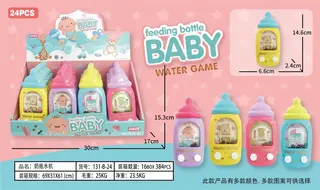
How many pieces is a carton? It depends entirely on the product, and the number is printed on every product page before you order. A carton of remote control aircraft may hold 72 pieces; a carton of small keychains may hold several hundred; a carton of a large playset may hold 12. You always see the figure, the per-carton price and the per-unit price together.
How many models can you mix? As many as you like. Twenty models, one carton each, is a normal order here — that is precisely what the model is designed for.
Do we break cartons? No, and not because we're inflexible. Opening a carton to pull out three pieces destroys the factory packaging, leaves the remainder unsellable as new, and creates acceptance problems at any marketplace warehouse. The rule protects the goods you receive as much as the goods we keep.
Why
A factory in Chenghai that sets a 1,000-piece MOQ is not being greedy. Producing 100 pieces of an item costs it nearly as much in setup as producing 1,000, and every small order occupies a line that could be running a large one.
What changes the equation is aggregation. We hold continuous order volume with 5,233 factories, so what looks to the factory like a full production commitment is, from your side, one carton out of a much larger flow. You are not asking a factory to make a special exception for a small buyer; you are taking a slice of an order it was already producing.
This is also why the goods are in stock rather than made to order. A carton you buy today is a carton that already exists.
How to test
The point of a low MOQ is not to spend less. It is to learn faster. A test buy that teaches you nothing is a waste of money regardless of its size.
Test across categories, not within one. Twenty variations of the same plush animal tell you about colours. One item each from ten different categories tells you what your customers actually buy. Our catalogue runs 38 first-level categories and 267 subcategories, which is enough range to test a whole shop's direction in one shipment.
Mix price levels deliberately. Include something at the bottom of the range, something mid, something premium. Margin behaves differently at each level and you cannot deduce one from another.
Mix light with dense — this one saves real money. Carriers bill the greater of actual and volumetric weight (length × width × height in cm ÷ 6000). Plush, balloons and large blister sets are light and bulky; building blocks, die-cast cars and board games are dense. A shipment of only plush pays for air. Combine them and the same consignment costs materially less per unit.
Volumetric weight explained →Aim the whole test at 100 kg. Not because we require it — because below that weight the freight rate stops working for you.
100 kg to Kazakhstan at the lower rate is $84 for the entire shipment. Thirty kilos costs roughly the same. The freight difference is close to zero and you get three times the goods. If your test comes to 30 kg, the right move is not «ship it» — it is «add seventeen more models».
And if you can't fill it today, we hold your cargo free for 30 days in Guangzhou while you build volume — from us or from other suppliers.
Assorted
Some cartons are single-variant; some are factory mixes. Where a product page says «assorted» or «mix colors», you receive a sealed factory mix: colours cannot be chosen and the exact split isn't guaranteed. Twelve pieces might arrive as three colours of four, or as five, four and three. That is how line packing works, and nobody in China recounts colours inside a sealed shipping carton.
This matters most when you build marketplace listings. Either use variations, or state «colour may vary» from the start. Sellers who find out at unboxing lose a week rebuilding cards.
If a single colour is essential, filter for items without the «assorted» tag — they exist in every category.
The unit
The carton is the unit you are actually purchasing, so it is worth knowing what the numbers attached to it mean before the first order rather than after.
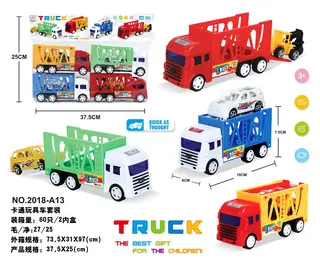
Piece count is set by physics, not policy. A carton holds whatever fits. Twelve for a large radio-controlled truck, twenty-four for a mid-size vehicle, one hundred and sixty-eight for a small doll, several hundred for keychains and figures. Nobody chose those numbers to make life difficult; they are the result of a box size, a product size and a packing pattern. This is why you cannot negotiate a half carton — the half carton has no box.
Two prices, one relationship. The per-carton price is the real one. The per-unit price is that number divided by the piece count, published so you can work out a margin without a calculator. When you compare our per-unit price against a retail price on a marketplace, you are comparing two different things, and the honest comparison is against what you would pay per unit from any other wholesale source at the same quantity.
Dimensions decide the freight. Every product page shows the carton's outer measurements. On dense goods they are informational. On light bulky goods they are the whole freight bill, because carriers charge the greater of actual weight and volume. A first order built without looking at that field can cost twice what the same money's worth of denser goods would.
The carton is also the claim unit. Factory cartons arrive sealed, with the model number and the piece count printed on the outside. That printed count is what a shortage claim is measured against. We do not open and repack them, because a repacked carton has no printed count and no traceable origin, and both of those are what make a claim provable rather than arguable.
Strategy
The most common expensive mistake is not ordering too much. It is ordering too little of too few things, learning nothing, and having to run the whole exercise again two months later.
Freight is billed on a minimum of 100 kg chargeable weight. Below that figure you pay for space you are not using, so the real question is not "how small can I go" but "what is the most informative way to fill 100 kg".
Spread across categories, not within one. Eight models from six categories tells you which shelf your customers respond to. Eight variants of the same vehicle tells you almost nothing you could not have guessed.
Mix dense with light deliberately. Plush, inflatables and large hollow toys ship by volume; die-cast, blocks and board games ship by weight. A load built only from the first group pays a volume penalty on every box. Mixing averages the density out and the dense goods effectively carry the light ones.
Buy the cheap unknowns and the reliable knowns together. Trend goods — fidget, squishy, gag — are cheap to test and tell you fast whether your audience follows trends at all. Evergreen goods pay the freight while you find out.
Keep one carton back. Photographing a full carton as it arrives, unopened, costs nothing and settles most disputes about what was shipped.
A first order built this way costs roughly the same as a timid one, because the freight floor is the same either way, and it comes back with information instead of a single data point.
Strategy
The first order answers whether the mechanism works. The second one is where a low minimum starts paying for itself, and the way you use it should change.
Concentrate where the data points. Everything that sold gets more cartons. Everything that did not gets dropped without ceremony — the whole reason for testing at carton scale is that dropping a model costs the price of a carton rather than the price of a season.
Widen deliberately, not randomly. The second order is the moment to test the neighbours of whatever worked. If mid-size vehicles moved, the informative next test is the categories that sit next to them on a shelf — remote-controlled models, blasters, building sets — rather than another eight vehicles.
Watch the freight ratio, not just the price. Keep the note of what each model actually cost to land per unit, freight included. A toy that is cheap to buy and expensive to move can easily be the worst item on a shelf while looking like the best one on an invoice.
Use consolidation on purpose. Goods sit free for 30 days. That means the second order does not have to be a single event: order as the first batch sells, let it accumulate, ship once. You get the cash-flow shape of small frequent orders and the freight cost of one larger one.
Reorder the same SKU, not the same photograph. Two factories make products that photograph identically. The SKU is what guarantees you are reordering the item your customers actually liked, and it is the field to keep in your own records.
By the third order most buyers have stopped thinking about the minimum at all, because it stopped being the binding constraint — the binding constraint is freight, and freight is a problem you solve by choosing assortment rather than by finding more capital.
Records
Nothing in this section requires software. A single sheet with three columns per model will tell you more about your business after two seasons than any dashboard, and almost nobody keeps it.
Landed cost per unit. Carton price plus that carton's share of the freight, divided by the piece count. This is the only cost figure that means anything, and it is frequently double the number on the invoice for light goods and barely above it for dense ones. Two models with the same purchase price routinely have landed costs that differ by half.
Days to sell through. How long one carton took to clear. A model that sells out in three weeks and a model that sells out in nine months can have identical margins and completely different value to you, because the first one recycles your capital four times a year and the second one occupies it.
Claim rate. How many units of that model came back, and why. One faulty unit in a carton is a normal manufacturing distribution. Five is a factory problem worth raising, and it is worth raising by SKU, because that is what lets us go to the specific supplier rather than to a category.
Keep those three numbers per SKU and the fourth and fifth orders stop being guesses entirely. You will also find, usually within a year, that the models you would have predicted to be your best sellers and the models that actually were have almost no overlap — which is the real argument for a low minimum, and one no supplier can make for you.
Honest limits
Honest limits, because knowing them beforehand is worth more than discovering them afterwards.
It doesn't make tiny shipments economical. One $20 carton is a valid order and we will ship it. But freight is charged on weight and volume, not on the value of the goods, so on a very small consignment the shipping can exceed the goods several times over. We allow it. We just want you to run the numbers first.
Samples — by agreement. Message us with the item number and we will agree the model, quantity and cost personally; samples are not ordered through the cart. A test carton also works — and it sells afterwards.
It doesn't replace certification. A low MOQ lets you test what sells; it doesn't tell you what you're allowed to sell. 44,336 catalogue items hold at least one test certificate on file from the factory, and the product page shows which — check that before you order, not after.
Documents, certification and customs →






















FAQ
More wholesale pages
Tell us what you need and we come back with a quote — contact us →