
P17466687538981798

Why a six-kilo carton can cost you like sixteen — and how to control it.






































International freight is not charged on the weight of your goods. It is charged on the greater of two numbers: actual weight and volumetric weight.
For most products that distinction barely matters. For toys it matters more than anything else. A plush toy weighs two hundred grams and occupies the volume of a brick. A playset in a large blister weighs half a kilo and takes up space you’ll pay three kilos for.
Below is the formula every carrier in the world uses, and the practice: how to know in advance whether your shipment bills on actual or volumetric weight, and what to do about it.
Volumetric weight = length × width × height (cm) ÷ 6000
The result is in kilograms. The 6000 divisor is used by air carriers and most consolidated freight; some express couriers use 5000, which makes volumetric weight larger still. Sea LCL is charged per cubic metre under a “weight or measure, whichever is greater” rule.
The carrier bills the greater of the two numbers. That isn’t greed, it’s physics: a truck, a container or an aircraft holds a fixed volume, and that space costs money regardless of what you put in it.
A carton of plush toys, 60 × 40 × 40 cm.
Volume: 60 × 40 × 40 = 96,000 cm³ = 0.096 m³
Volumetric weight: 96,000 ÷ 6000 = 16 kg
Actual weight: about 6 kg
You pay for 16. Almost a threefold difference — and it only fails to arrive as a nasty surprise if you calculated it beforehand.
The same carton filled with building blocks: actual weight 22 kg, volumetric still 16. You pay for 22 — actual weight wins, and that is ideal freight density.
Divide the carton’s weight by its volume in cubic metres. That gives you density in kilograms per cubic metre.
Above 167 kg/m³ — you’re billed on actual weight.
Below 167 — you’re billed on volume, i.e. you’re shipping air.
The number 167 isn’t ours; it is simply 1000 ÷ 6, the other side of the 6000 divisor.
How that maps onto our categories:
| Usually bills on actual weight | Usually bills on volume |
|---|---|
| building sets and blocks | plush and soft toys |
| die-cast cars and vehicles | balloons |
| board games and puzzles | playsets in large blisters |
| watches, keychains, jewellery | play structures and ride-ons |
| fidget and small-motor toys | inflatable beach goods |
A guide, not a law — any individual item can have any dimensions. Exact weight and volume for every position are on the product page, and the cart calculates from those, not from our generalisations.
One: mix dense goods with light ones. This is the big one, and almost nobody uses it. Ship only plush and you are paying for volume. Add building sets, die-cast cars or board games to the same consignment and they fill the weight you have already paid for through volume — arriving almost free. In practice a balanced consignment costs a quarter to a third less per unit than a shipment of a single light-weight category.
Two: don’t repack. A factory carton is designed around a specific stacking pattern with almost no dead space. Any “let’s make it neater” repacking adds air, and you pay to ship air. This is one reason we never open factory cartons — not only for shelf appearance, but for your freight bill.
Three: calculate before you order, not after. Every product page lists carton dimensions and weight. The cart totals them across the shipment and shows the final delivered cost before you pay. There is exactly one way to get this wrong: not looking.
The two rules work together, and together they shape your landed cost more than the price of the goods does.
The 100 kg minimum is measured the same way — on the greater of actual and volumetric. So a plush consignment with an actual weight of forty kilos may already “weigh” a hundred to the carrier, in which case the minimum costs you nothing. Meanwhile a hundred kilos of building sets occupies half a cubic metre and fits comfortably inside the rate.
One practical conclusion: build your shipment weight with volume in mind, not just mass. Calculate both numbers, work from the larger one, and top up to 100 kg against that.
The rule that volume can outweigh weight looks like a trick until you look at what a carrier actually sells. An aircraft hold, a container and a trailer all run out of room long before they run out of load capacity when the cargo is light. What is being sold is space, and a box of feathers occupies the same space as a box of bolts.
Every carrier therefore computes a notional weight from the box's dimensions and bills the greater of that and the real weight. It is not a penalty and it is not aimed at you — it is the only way a business that sells space can price cargo that does not weigh anything.
Two consequences follow that are worth internalising. First, the box matters as much as the contents: the same goods in a carton twenty per cent smaller cost twenty per cent less to move. Second, empty space inside a carton is something you are paying to transport, which is why factory compression is a discount and not a packaging detail.
Soft toys are the classic case. Light, bulky, and almost always billed on volume.
Inflatables and pool goods are worse, because they are mostly air by design.
Large hollow plastic — ride-ons, playhouses, big vehicles — combines volume with awkward shapes that pack badly, so the effective density is lower still.
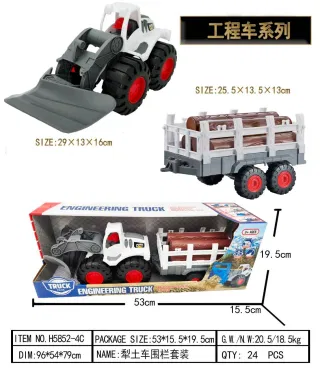
Packaging-heavy goods are the case nobody expects: a small toy in a large display box ships as the box, not as the toy. Presentation cartons and blister packs can double a shipment's volume without adding anything a customer values enough to pay freight for.
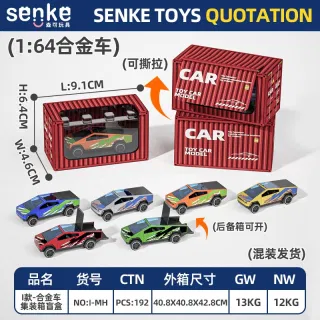
The opposite end — die-cast, blocks, board games, tools, anything metal or densely moulded — is billed on real weight, and those goods are what make a mixed load work.
Most buyers compute volumetric weight after choosing an assortment. It is far more useful before.
Start from the freight budget rather than from the goods. Decide what you are willing to spend on moving the order, convert that into a chargeable weight at your route's rate, and treat that number as the space you have to fill. Then build the assortment to fit it, mixing dense goods with light ones until the load's average density crosses the threshold and you are billed on real weight.
Done this way, freight becomes a design constraint rather than a bill that arrives later. It also changes which products look attractive: two toys with the same purchase price and different densities have materially different landed costs, and the denser one is quietly the better business.
One practical shortcut: for any product you are considering in quantity, divide the carton's real weight by its volume in cubic metres. If the answer is comfortably above the threshold, freight will behave. If it is far below, that product needs a dense companion in the same shipment or it will cost more to move than it looks.
Two honest limits, because a calculator page that only says "pack tighter" is incomplete.
You cannot compress your way under the 100 kg floor. The minimum chargeable weight applies regardless of how efficiently the goods are packed. Below it, efficiency saves you nothing at all, which is why very small orders should be made bigger rather than tighter.
You cannot repack factory cartons to game the number. We do not open sealed factory cartons, because the printed count and the factory seal are what make a shortage or damage claim provable. Saving a few kilos of volumetric weight is not worth losing the evidence chain on an entire shipment.
Abstract formulas convince nobody. Two shipments, same money spent on goods, different outcomes.
Shipment A — plush only. Twelve cartons of soft toys. Each carton measures 60 × 40 × 40 cm and weighs about 6 kg. Actual weight for the load is roughly 72 kg. Volumetric weight is 16 kg per carton, so 192 kg for the load. The carrier bills the greater figure: 192 kg. Nearly two thirds of what is being paid for is air, and because the actual weight is below the 100 kg floor, a smaller version of this shipment would have been billed at 100 kg regardless.
Shipment B — the same twelve plush cartons plus six cartons of die-cast vehicles. The die-cast cartons are the same size and weigh about 22 kg each. Actual weight is now 72 + 132 = 204 kg. Volumetric weight is 16 × 18 = 288 kg. The carrier still bills the greater — 288 kg — but the load now contains far more sellable goods for each billed kilogram. Per unit of merchandise, Shipment B moves goods substantially cheaper than Shipment A, and the plush effectively rode along on the density of the vehicles.
The lesson is not that plush is a bad product. It is that plush shipped alone is an expensive way to move air, and the fix costs nothing: put something dense in the same shipment.
Five checks, all answerable from the product page, all faster than a freight quote.
What are the carton's outer dimensions? This is the input to everything else. If it is not published, that is itself information.
How many pieces are in that carton? Volumetric cost per unit is what matters, and a large carton with many small units can be perfectly fine.
Is the packing compressed? Compressed plush and vacuum-packed textiles change the arithmetic dramatically.
Is the retail packaging doing damage? A small toy in a large display box ships as the box. Sometimes the presentation is worth it; often it is not, and it is worth knowing which before ordering hundreds.
What dense goods am I ordering alongside it? If the answer is none, expect a volumetric bill and decide whether the product still works at that landed cost.
Four things people reliably get wrong, in ascending order of how much they cost.
Thinking the divisor is universal. It is a convention, and it varies by mode and by carrier. The principle — billed on the greater of weight and space — is universal; the exact number is not. Always confirm which divisor applies to your route before using a calculation for a budget.
Measuring the product instead of the carton. Carriers measure the box, including its walls and any void inside. The toy's own dimensions are irrelevant to freight.
Averaging across a shipment by eye. Volumetric weight is computed per carton and summed, not estimated from the load as a whole. A shipment can be dense on average and still contain several cartons billed on volume.
Assuming a lighter product is a cheaper product. On volumetric-billed goods, removing weight without removing volume changes nothing at all about the freight. Only smaller boxes change the freight, which is why compression matters and lightweight materials often do not.
A calculator page can leave the impression that volume is the only thing that matters. For a large share of orders it is not, and knowing which situation you are in prevents optimising the wrong thing.
Dense assortments. Die-cast, blocks, board games, tools and anything metal are billed on real weight. Compressing them changes nothing, and time spent on packaging efficiency is time wasted.
Shipments under the floor. Below 100 kg chargeable weight you pay the minimum regardless. Volumetric optimisation on a 40 kg shipment saves precisely nothing — the correct move is to add goods, not to shrink boxes.
Container loads. A full container is priced as a container. Inside it, space efficiency matters to how much you can fit, not to what you are billed.
Very high-value goods. When the merchandise value per carton is large, freight becomes a small percentage of landed cost and optimising it hard is a poor use of attention.
The situation where volumetric weight genuinely dominates is narrow and specific: a part-load shipment, above the floor, of light bulky goods. That is exactly where soft toys, inflatables and packaging-heavy items live, and it is why those categories deserve the arithmetic while others do not.
The arithmetic on this page becomes useful the moment it turns into a rule you apply without recalculating.
For each product you are considering in quantity, take the carton's real weight and its volume in cubic metres from the product page, and divide. What comes back is a density figure, and where it sits relative to the threshold tells you how that product will behave in freight.
Comfortably above: the product ships on real weight. Buy it on its merits and stop thinking about freight.
Near the line: it will be billed one way in a dense shipment and the other way in a light one. Its landed cost depends on what you ship it with.
Far below: it will always be billed on volume alone. That is not a reason to avoid it — light goods include some of the best-selling categories in the trade — but it is a reason never to ship it by itself, and a reason to check that the margin survives a volumetric freight line.
Applied consistently, this single division turns freight from a bill that arrives into a number you already knew, and it changes which products look attractive in a way no price list can.
FAQ